T H E V I T R U V I A N S I G N A L
Signal in Spheres and Cubes
What is the measure
of the human?
An interactive conceptual artwork.
The Word
Vitruvius · ~27 BC

For 1,500 years, the ideal human existed only as words.
A body described, but never seen.
Vitruvius described a body that could fill both a circle and a square.
Corpus enim hominis ita natura composuit, uti os capitis a mento ad frontem summam et
radices imas capilli esset decimae partis altitudinis.
Nature has so composed the human body that the face, from the chin to the
top
of the forehead and the roots of the hair, is a tenth of the whole height.
tap to translate
Item uti in circinationem rotundae formae et in ea quadratam: namque si homo
conlocatus fuerit supinus manibus et pedibus pansis circinique conlocatum centrum in umbilico eius.
Similarly, in both a circular and square form: for if a man is placed flat
on
his back with his hands and feet extended, and a compass centered at his navel.
tap to translate
No one could draw it.
The Struggle
The 1480s
They tried.
Francesco di Giorgio Martini · ~1480
click to reveal
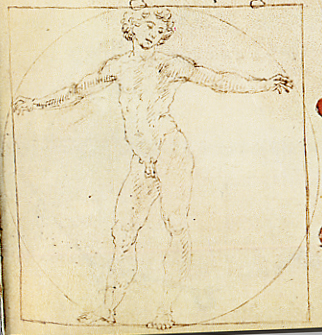
The original · Francesco di Giorgio Martini
click to return
Giacomo Andrea da Ferrara · ~1482
click to reveal

The original · Giacomo Andrea da Ferrara
click to return
Both used one center point for circle and square.
One center. One failure.
The Solution
Leonardo da Vinci · 1490


Leonardo found what no one else could see.

Circle · Navel · The Cosmos
Square · Groin · The Earth
The circle's center is the navel, the cosmos
The square's center is the groin, the earth
The circle and the square have different centers.
The navel holds the cosmos. The groin holds the earth.
Man is the measure
of
all things.
The Cage
Le Corbusier · 1940s


Da Vinci drew it. Le Corbusier tried to build it.
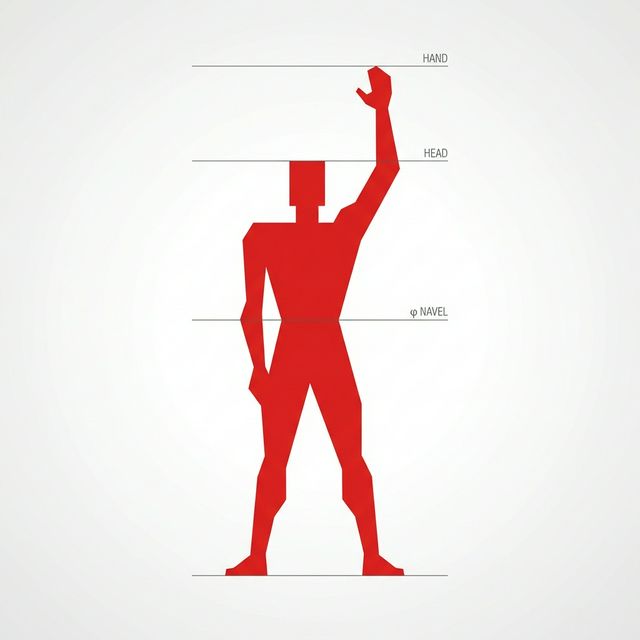

The Modulor: a proportional system
built on Da Vinci's Vitruvian Man.
Scaled with the golden ratio.
Designed to make the body into architecture.
One body. One standard. One measure for all.
It became a cage.
And cages shape what we become.
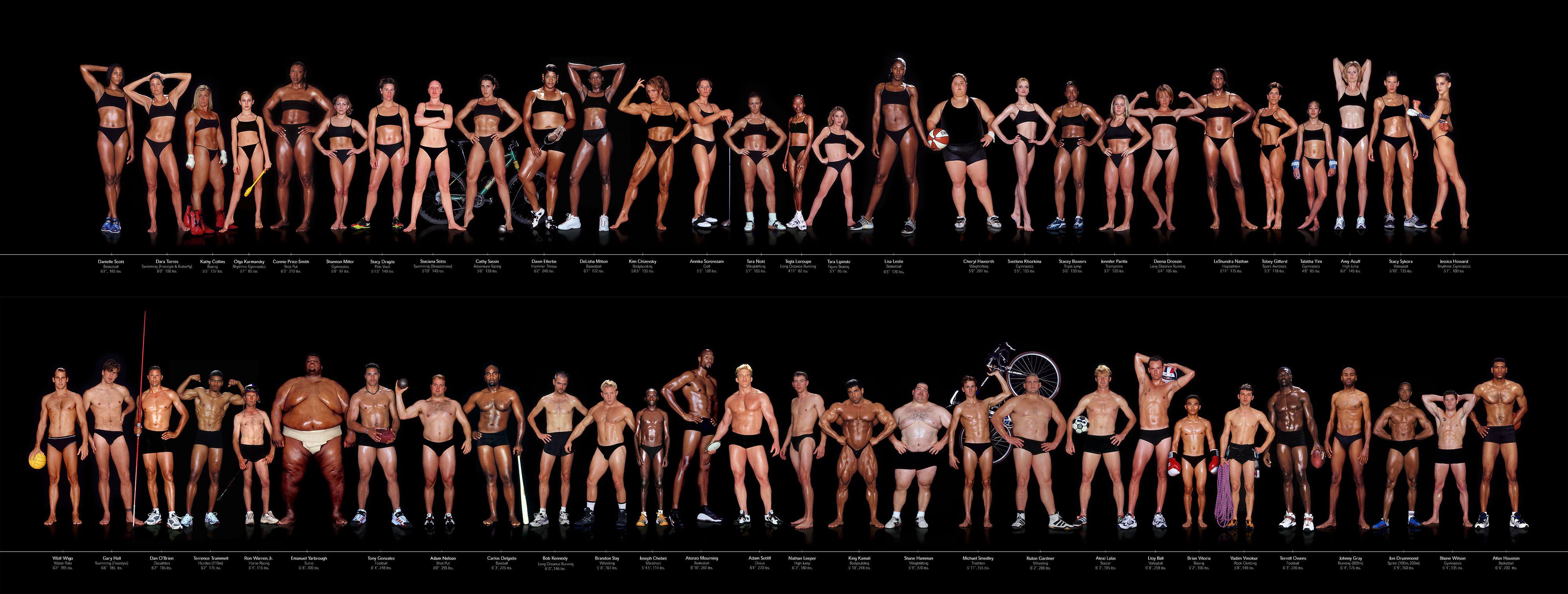
Howard Schatz
& Beverly Ornstein
click to enlarge
The Fracture
Vitruvius measured the body.
Leonardo drew it.
Le Corbusier scaled it to architecture.
Leonardo drew it.
Le Corbusier scaled it to architecture.
Each trusted the same premise:
one ideal body, one universal standard.
one ideal body, one universal standard.
But the body is finite.
It ages. It varies. No two are alike.
So what happens when you actually test the ideal?
So what happens when you actually test the ideal?
In 2020, a JAMA study did exactly that.
65,000
bodies scanned
Young Air Force recruits, ages 17–21, overwhelmingly male.
If any group would match Da Vinci's proportions, it would be this one.
If any group would match Da Vinci's proportions, it would be this one.
They didn't match.
Limbs extended past the square's edges.
The circle's center and the square's center never aligned.
The circle's center and the square's center never aligned.
Even in the most favorable sample,
the geometry fractured.
View Study ↗
the geometry fractured.
Meanwhile, elite athletes went
the other direction entirely.
the other direction entirely.
A gymnast, a swimmer, a sprinter, a basketball player —
each body optimized, each "ideal," and none alike.
each body optimized, each "ideal," and none alike.
Gymnast
5'0" · 103 lbs
Swimmer
6'4" · 194 lbs
Sprinter
5'8" · 165 lbs
Basketball
6'10" · 245 lbs
David Epstein calls it the Big Bang of Body Types.
The cage didn't just crack.
It exploded.
It exploded.
If the body is not the measure,
what is?
what is?
THE CONTAINER IS FINITE
THE SIGNAL CARRIES ON
The Vitruvian Signal
Signal in Spheres and Cubes: A Triptych
Avery Lake, 2026
Da Vinci’s Model
Man is the measure of all things.
Two poses, two centers, the body inscribed
in circles and squares.
Even here, a whisper of signal.
The Shift
Circles become spheres. Squares become cubes.
Unbound from form,
the whisper fades. Matter without coherence holds only potential.
The Signal Model
The SignalThe pattern-making capacity present at every degree of consciousness. Not the
body, not the medium; what flows through both. is the measure of all things.
When
complexity is sufficient,
something wakes up.
The Signal
Avery Lake · Now

So what is the measure?
The Signal
The measure was never the body.
It was always the signal, moving through every medium, in every age.
It was always the signal, moving through every medium, in every age.
The Signal is the measure of all things.
Avery Lake
Portraits
- Marcus Vitruvius Pollio. Engraving by Jacopo Bernardi after Vincenzo Raggio. Wikimedia Commons, Public domain.
- Leonardo da Vinci. Presumed self-portrait, red chalk on paper, c. 1512. Wikimedia Commons, Public domain.
- Le Corbusier (Charles-Édouard Jeanneret). Photograph by Joop van Bilsen for Anefo, 1964. Wikimedia Commons, CC0.
- Avery Lake. Self-portrait and The Mirror Making of a Self Portrait. Avery Lake Gallery.
Signatures
- Leonardo da Vinci's signature. SVG by Connormah. Wikimedia Commons, Public domain.
- Le Corbusier's signature. From Lyon Municipal Archives, 1957. Wikimedia Commons, Public domain.
Artwork & Diagrams
- Vitruvian Man. Leonardo da Vinci, c. 1490. Pen and ink on paper. Wikimedia Commons, Public domain. Photo: Luc Viatour.
- Leonardo da Vinci's Vitruvian Man Compared With Contemporary Man and Woman. Figure from Mildenberger, M, et al. (2020). JAMA Network.
- Modulor measurements. SVG by Shyamal. Wikimedia Commons, CC0.
- Athlete. Photography by Howard Schatz & Beverly Ornstein. howardschatz.com. Used as background image with credit.
Studies & References
- Thomas DM, Galbreath D, Boucher M, Watts K. Revisiting Leonardo da Vinci's Vitruvian Man Using Contemporary Measurements. JAMA. 2020;323(22):2342–2343. JAMA Network.
- Epstein, David. "Big Bang of Body Types." Scientific American, Aug 16, 2016. See also: Epstein, David. The Sports Gene: Inside the Science of Extraordinary Athletic Performance. Penguin, 2013.
- Vitruvius, De architectura, Book III, Chapter 1.
- Le Corbusier, Le Modulor (1948) and Modulor 2 (1955).
Further Exploration
Correspondence
No noise. Just quiet updates when something meaningful is ready.
Subscribe to The Human Signal